

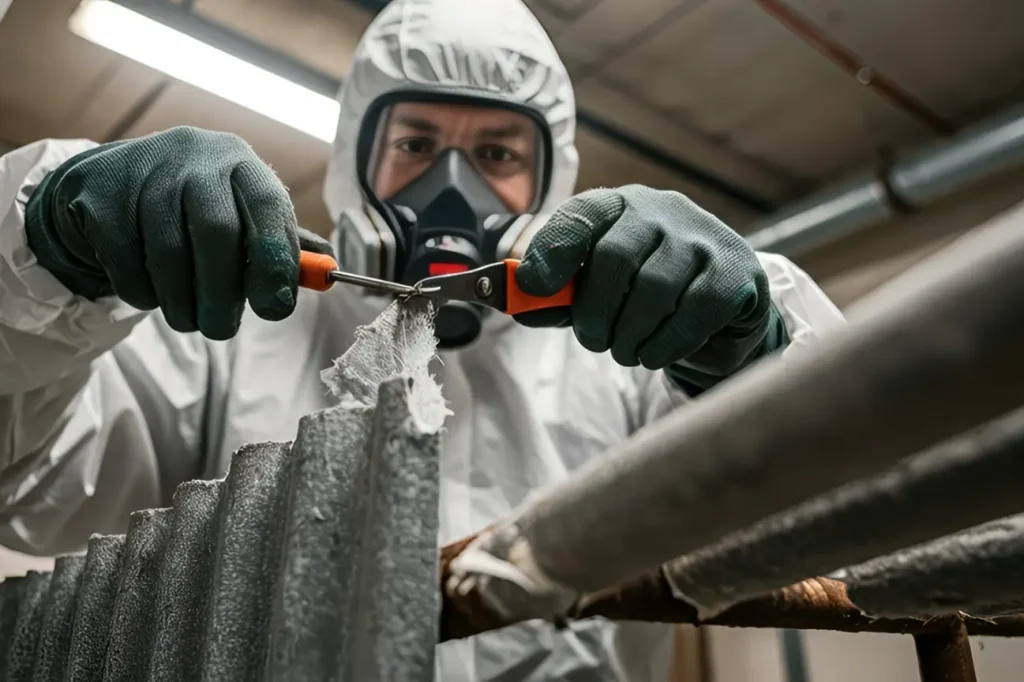
Not all asbestos remediation companies are the same. Some are fly-by-night operators working out of vans with minimal equipment and no proper credentials. Others are established, ISO-certified contractors with decades of experience, state-of-the-art equipment, and a track record of safe, compliant work.
From the outside, it’s not always obvious which is which. Both types of companies will give you a quote. Both will show up in work gear. Both will promise to remove your asbestos safely and legally. But only one of them will actually deliver on that promise—and only one of them will protect you from liability, contamination, and regulatory violations.
So what separates a professional asbestos remediation company from an amateur or unreliable one? It comes down to six core elements: licensing, insurance, experience, systems, equipment, and accountability.
Here’s what you should be looking for—and why each element matters.
1. Valid NSW Asbestos Removal Licensing
This is the foundation of professional asbestos remediation. In NSW, removing more than 10 square metres of non-friable asbestos or any amount of friable asbestos requires a licence issued by SafeWork NSW.
There are two types of licences, and each has specific requirements:
Class A Licence (Friable Asbestos Removal)
This is the highest level of asbestos removal licensing. Class A licence holders can remove any type of asbestos—friable or non-friable—and are trained to handle the most dangerous materials.
Friable asbestos is material that can be crumbled by hand when dry, which means it releases fibres easily into the air. Examples include loose-fill insulation, degraded pipe lagging, and damaged asbestos cement that’s breaking down.
To obtain a Class A licence, contractors must demonstrate:
- Completion of accredited asbestos removal training
- Understanding of NSW regulations and SafeWork NSW codes of practice
- Competence in high-risk removal techniques
- Proper equipment and safety management systems
Class B Licence (Non-Friable Asbestos Removal)
Class B licence holders can remove non-friable (bonded) asbestos materials in quantities exceeding 10 square metres. Non-friable asbestos is bonded with cement or other materials and is more stable than friable asbestos—but it still requires proper handling, containment, and disposal.
Examples include asbestos cement sheeting used in walls, roofs, and fencing.
Class B licensing requires training in safe removal methods, containment procedures, and compliance with NSW regulations.
Why Licensing Matters
Licensing isn’t just a regulatory checkbox—it’s proof that the contractor has undergone formal training, understands the health risks, and is accountable to SafeWork NSW for their work.
Unlicensed contractors don’t have this accountability. If they contaminate your property, expose workers, or dispose of asbestos illegally, there’s no regulatory body overseeing them. And if something goes wrong, you—the property owner—are left holding the liability.
How to Verify Licensing
Don’t take a contractor’s word for it. Ask for their licence number and verify it on SafeWork NSW’s public register. The register lists all active asbestos removal licences in NSW, along with the contractor’s name, licence type, and expiry date.
If a contractor can’t provide a licence number, or if the number doesn’t appear on the register, don’t hire them. It’s that simple.
2. Comprehensive Insurance Coverage
Asbestos remediation is high-risk work. Materials can break unexpectedly. Containment systems can fail. Workers can be exposed. Neighbouring properties can be contaminated. And when these things happen, someone has to pay for the cleanup, the medical expenses, the legal fees, and the compensation claims.
A professional asbestos remediation company carries two essential types of insurance:
Public Liability Insurance
This protects you—the property owner—if the contractor’s work causes damage to your property, a neighbouring property, or results in injury to third parties.
For example, if asbestos fibres spread to a neighbour’s yard during removal, public liability insurance covers the cost of decontamination, legal defence, and any compensation claims.
Coverage amounts vary, but reputable contractors typically carry at least $10 million in public liability coverage. For larger commercial projects, $20 million or more is standard.
Workers’ Compensation Insurance
This covers the contractor’s employees if they’re injured or become ill as a result of their work. Asbestos exposure, respiratory injuries, and physical accidents are all covered under workers’ compensation.
Without this coverage, an injured worker can sue the property owner for compensation. And because NSW law requires all contractors with employees to carry workers’ compensation insurance, operating without it is illegal.
Why Insurance Matters
Insurance is your financial protection. If something goes wrong—and in asbestos work, things can go wrong—you need to know that the contractor’s insurance will cover the costs, not your savings or your property equity.
How to Verify Insurance
Ask for current certificates of currency for both public liability and workers’ compensation insurance. These certificates should show:
- The insurer’s name and policy number
- The coverage amounts
- The policy expiry date
- The contractor’s business name as the insured party
If a contractor can’t provide these certificates, or if they’re expired, don’t proceed. It’s not worth the risk.
3. Proven Experience and Industry Knowledge
Asbestos remediation isn’t a business you can master in a weekend training course. It requires years of hands-on experience, exposure to different types of projects, and a deep understanding of how asbestos behaves in various conditions.
Professional asbestos remediation companies have:
Long-Standing Industry Presence
Companies that have been operating since the late 1980s or early 1990s—when asbestos removal first became heavily regulated—have seen it all. They’ve handled residential removals, commercial projects, industrial site remediation, soil contamination, and emergency responses.
This experience translates into better problem-solving, more accurate quoting, and fewer surprises during the work.
Specialised Supervisors and Removal Personnel
The best asbestos removal teams include supervisors who have been in the industry for decades and removal personnel who are trained, certified, and experienced in handling both friable and non-friable materials.
These teams understand how to identify asbestos types, assess risk, adapt to site-specific challenges, and execute removal work safely and efficiently.
Diverse Project Portfolio
A professional company should be able to demonstrate experience with projects similar to yours—whether that’s residential roof removal, commercial building remediation, telecommunications infrastructure, or contaminated soil excavation.
Ask for case studies, references, or examples of past work. If they can’t show you a track record, that’s a warning sign.
4. ISO-Certified Safety and Quality Management Systems
ISO certification isn’t legally required for asbestos remediation companies, but it’s a strong indicator of professionalism and accountability.
Two key certifications are particularly relevant:
ISO 45001 (Occupational Health and Safety Management)
This international standard requires companies to implement documented safety procedures, conduct regular risk assessments, train employees on safety protocols, and continuously improve their health and safety performance.
Companies with ISO 45001 certification are regularly audited by independent third parties to ensure compliance. This means their safety systems are transparent, consistent, and effective.
ISO 9001 (Quality Management)
This standard focuses on quality control, customer satisfaction, and continuous improvement. It requires companies to document their processes, maintain traceability of all work, conduct internal audits, and address non-conformances systematically.
For asbestos remediation, ISO 9001 ensures that every project follows the same high standards, that documentation is complete and accurate, and that clients receive consistent, reliable service.
Why ISO Certification Matters
ISO-certified companies operate under systems that are independently verified. This reduces the risk of shortcuts, inconsistencies, or compliance failures. It also provides you with confidence that the contractor’s processes are robust and regularly reviewed.
While not every good contractor is ISO-certified, it’s a strong signal of professionalism—and something worth prioritising when comparing companies.
5. State-of-the-Art Equipment and Technology
Professional asbestos remediation requires specialised equipment that most contractors don’t own or maintain.
Negative Air Pressure Units
These systems create a controlled environment where air is continuously pulled inward and filtered through HEPA units, preventing fibres from escaping the work zone. Negative air pressure is essential for indoor friable asbestos removal.
HEPA Filtration Systems
High-Efficiency Particulate Air (HEPA) filters capture microscopic asbestos fibres that would pass through standard filtration. Professional contractors use HEPA vacuums for decontamination and HEPA filters on negative air units.
Decontamination Facilities
Multi-stage decontamination units allow workers to shower and change out of protective gear before leaving the work zone, preventing fibres from spreading.
Personal Protective Equipment (PPE)
Professional teams use full-body disposable suits, P1 or P2 respirators, gloves, and safety boots. This equipment is single-use and disposed of as asbestos waste after each shift.
Air Monitoring Equipment
Real-time air monitoring devices track fibre concentrations during work, ensuring that containment measures are effective and that exposure risks are minimised.
Why Equipment Matters
The right equipment doesn’t just make the job easier—it makes it safer. Contractors who operate with substandard or insufficient equipment are more likely to cause contamination, expose workers, or fail clearance testing.
6. Commitment to Independent Validation and Documentation
The mark of a professional asbestos remediation company is their commitment to third-party validation and complete documentation.
Independent Clearance Testing
After remediation is complete, an independent licensed assessor—not the contractor who did the removal—conducts air quality testing. Samples are collected from the work zone and analysed by a NATA-accredited laboratory.
If the site passes clearance (meaning fibre concentrations are below safe exposure limits), the assessor issues a clearance certificate. If it doesn’t pass, the contractor re-cleans the site and retests until it does.
This independent validation is critical because it ensures objectivity. A contractor who tests their own work has a conflict of interest—they benefit from the site passing clearance. An independent assessor has no stake in the outcome and reports the results accurately.
Comprehensive Documentation
Professional contractors provide:
- Pre-work asbestos assessments and lab test results
- Remedial action plans
- Photographic evidence of the work
- Clearance certificates from independent assessors
- Air monitoring reports
- Waste disposal receipts from licensed facilities
- Updated asbestos registers (if applicable)
This documentation protects you in multiple ways. It proves the work was done legally, it supports property value during sales, it satisfies insurance requirements, and it provides evidence in case of future disputes or liability claims.
How WBS Engineers Embodies Professionalism
At WBS Engineers, we meet every one of these professional standards—and we’re transparent about it.
We hold full Class A and Class B asbestos removal licences, and our licence numbers are publicly verifiable on SafeWork NSW’s register. We carry comprehensive public liability and workers’ compensation insurance with coverage amounts that exceed industry minimums—and we’re happy to provide current certificates of currency to any prospective client.
Our teams include supervisors and removal personnel with decades of asbestos remediation experience, spanning everything from small residential projects to large-scale commercial and industrial sites. We’ve been in the industry since its early days, and we’ve seen—and successfully handled—every type of asbestos challenge NSW properties can present.
We operate under ISO 45001 (occupational health and safety) and ISO 9001 (quality management) certified systems, which means our processes are documented, regularly audited by independent third parties, and continuously improved based on performance data and client feedback. These aren’t just certifications we hold for marketing purposes—they’re living systems that guide how we work on every single project.
Our equipment inventory includes state-of-the-art negative air pressure units, industrial HEPA filtration systems, multi-stage decontamination facilities, and real-time air monitoring devices. We invest in maintaining and upgrading our equipment because we know that cutting-edge tools make the difference between adequate containment and exceptional containment.
And we work with independent licensed assessors to conduct clearance testing on every job—no exceptions. We don’t self-certify. We don’t skip validation. We don’t consider a project complete until the site passes clearance and we’ve provided you with full documentation that includes lab reports, clearance certificates, disposal receipts, and photographic evidence.
What our clients value most about working with WBS Engineers is our commitment to communication and education. We don’t just show up, do the work, and leave. We take time to explain what we’re doing, why we’re doing it, and what you should expect at each stage. We answer questions clearly and without condescension. We provide regular updates throughout the project. And we make ourselves available after completion if you have questions or need additional documentation.
We’ve built our reputation over years of consistent, high-quality work across hundreds of NSW projects. We don’t rely on high-pressure sales tactics or low-ball pricing to win business—we let our credentials, our track record, and our client testimonials speak for themselves.
The Difference Professionalism Makes
Choosing a professional asbestos remediation company isn’t just about compliance—it’s about outcomes.
Professional companies don’t just remove asbestos. They manage risk. They protect health. They ensure legal compliance. They provide documentation that stands up to scrutiny. And they take accountability when issues arise.
Amateur or unreliable contractors might get the material off your property, but they leave behind contamination, liability, and uncertainty. And fixing that aftermath costs far more than hiring the right company in the first place.
When you’re evaluating asbestos remediation companies, look for the six core elements of professionalism: valid licensing, comprehensive insurance, proven experience, ISO-certified systems, state-of-the-art equipment, and commitment to independent validation.
These aren’t luxuries. They’re necessities. And they’re what separate companies that do asbestos work from companies that do asbestos work right.

 contact@wbsnsw.com.au